If 84000 were to have a signature outreach activity, it would surely be its series of resoundings. Reading the words of the Buddha aloud is said to benefit oneself and all those who can hear them, and so, designed to engage our audiences and readers, resoundings are a distinctly participatory activity that emulate the traditional monastic practice of reading aloud the entire Kangyur.
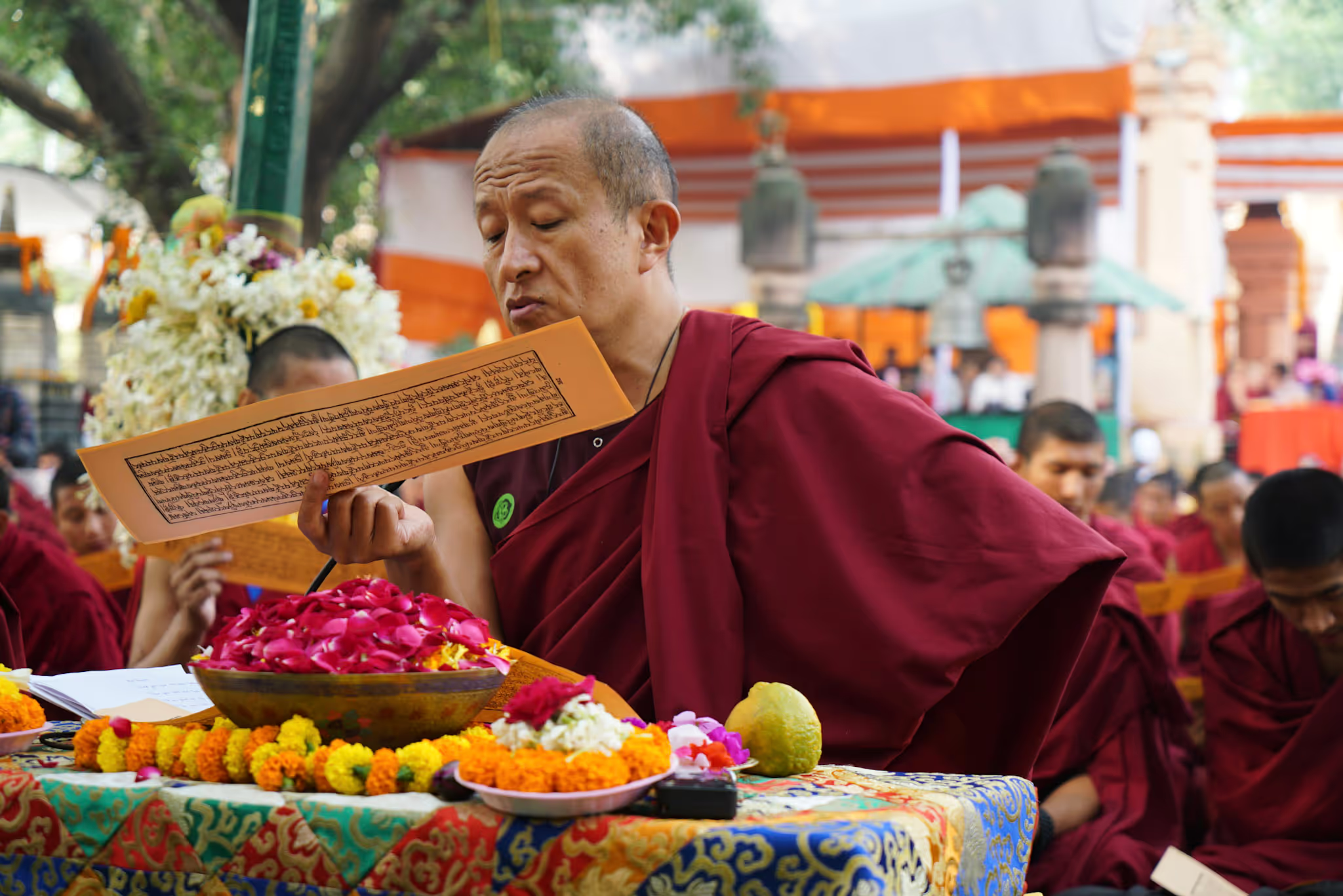
For centuries, monastics across Asia have read the Buddha's words aloud, not silently, not privately, but collectively, filling the air with teachings that might otherwise remain on a page. A Sūtra Resounding draws on that tradition and adapts it for anyone who wants to engage with these texts directly, whether in a community setting or quietly on your own.
With 84000's translations now available in English, that practice is open to everyone.
A Sūtra Resounding is one of the simplest and most immediate ways to connect with the Buddha's teachings. No prior experience is required, no elaborate preparation. You open a text, you read aloud, and something happens, not just in the mind, but in the room.
This guide is an invitation to try it yourself, with others or alone, using 84000's Reading Room.
A Sūtra Resounding is rooted in the traditional monastic practice of reading the entire Kangyur aloud—each participant taking a sūtra or section until the text is collectively complete. The 84000 approach adapts this for any setting: any number of people, reading together or at different times, ensuring as much of the text as possible is spoken aloud.
The practice itself is straightforward. Open a sūtra to any page and read. Those who wish may begin with opening prayers, close with a dedication of merit, or combine the practice with others they already have. Ideally, a sūtra is read in its entirety, but even a single section is worthwhile.
Resounding invites a different kind of engagement with a text; slower, more attentive, more embodied than reading silently. It can deepen familiarity with the teachings, spark insight, and inspire further study or the wish to seek guidance from a teacher. Traditionally, it is understood to strengthen the imprint of Dharma in the mind, reduce distraction, and plant seeds of wisdom in those who hear the words. It can also be offered as a gift; for a birthday, a marriage, the birth of a child, or in times of illness or loss.
A Resounding can happen anywhere, alone at home, with a small group of friends, within a community, or as part of a larger gathering such as 84000's biennial Resoundings Under the Bodhi Tree. You might pledge a chapter, join others online, or simply make reading aloud a personal practice. The format is flexible; what remains constant is the act of giving voice to the Buddha's words.
A Resounding can take place at any time and in any setting, there is no wrong occasion. That said, certain moments lend themselves naturally to the practice.
Holy days and festival periods offer a meaningful context, as do teaching events, where a Resounding can precede or follow instruction on the sūtra being read. Sangha gatherings are another natural fit, creating space for shared practice and conversation about the text afterward.
A Resounding can also be offered as a gift. Traditionally, it is a way to generate and dedicate merit on behalf of others, for a birthday, a marriage, the arrival of a new child, a milestone anniversary, or in support of someone facing illness. It can equally be offered in remembrance of those who have passed.
There is no minimum size. A Resounding held alone, in a quiet room, carries the same intention as one held in a monastery or under the Bodhi Tree.
Beginning a Resounding requires very little. Here is how to do it.
1. Find a sūtra Visit the 84000 Reading Room at readingroom.84000.co. Browse by title, theme, or length. If you are unsure where to start, the Most Read texts are a good entry point. Any published translation is suitable for resounding.
2. Choose where to begin Open the sūtra to the body of the text , this is the main teaching, which follows the prologue or setting of the scene. You may begin at any point. You do not need to start at the beginning, though reading a sūtra in its entirety is encouraged when time allows.
3. Set your intention Before reading, take a moment to settle. Those who wish may recite opening prayers (see Prayers section below). Others may simply pause and reflect on why they are reading; for their own understanding, in dedication to someone, or as an offering to all who might benefit.
4. Read aloud Read at your own pace, clearly and audibly. There is no required speed or style. If reading with others, each person reads their own section simultaneously, voices overlap, which is both traditional and intentional.
5. Close with dedication When you have finished, dedicate the merit of the practice. Closing prayers are provided below, or you may dedicate in your own words.
Any sūtra published in the 84000 Reading Room is suitable for resounding. A few considerations can help you choose well.
Length Some sūtras are short enough to be read in a single sitting; others span multiple volumes and are better suited to a group resounding spread across time. If this is your first Resounding, a shorter text allows you to complete it in one session and get a sense of the full arc of the practice.
Content and character Sūtras vary considerably in style. Some are primarily philosophical; others are narrative, rich with characters and story. Some are devotional, closer in feel to prayer. Browsing the Reading Room's thematic collections can help you find a text that matches your interest or the occasion.
Audience If resounding with a group, consider the background of those participating. A narrative sūtra may be more immediately accessible to newcomers; a more philosophical text may suit a group with existing familiarity with Buddhist thought.
Language 84000's translations are in English. If your group includes speakers of other languages, participants may read simultaneously in different languages, this is consistent with the traditional monastic practice on which Resounding is based.
Format For a solo or informal resounding, reading from a screen works well. For a group event, you may wish to print sections in advance so participants can read without needing a device.
A group Resounding can be as simple as a few friends gathering in a living room or as large as a community event with a presiding teacher. The principles are the same regardless of scale.
Roles
A well-run Resounding typically involves a few key people:
Teacher or presider — someone who can speak briefly to the significance of the practice and introduce the sūtra. This need not be a formal teacher; a knowledgeable member of the community can serve this role.
Emcee — introduces the event, explains how the Resounding will work, and guides participants through the schedule.
Text coordinator — prepares and distributes the sūtra sections, whether printed or digital, and ensures each participant knows which section they are reading.
Volunteers — assist with logistics before, during, and after the event.
For smaller gatherings, one or two people can cover all of these roles.
Venue
Choose a space that is quiet enough for voices to be heard and comfortable enough for the duration of the session. For outdoor events, consider lighting if the Resounding extends into the evening. Ensure the space can accommodate your group comfortably, with room for participants to hold and read their texts.
Schedule
A Resounding typically runs between sixty and ninety minutes. A sample schedule:
Publicizing Your Event
If you are opening your Resounding to a wider community, share the following information in advance: the occasion and purpose, the sūtra being read and a download link from the Reading Room, the date, time, and location, and any instructions for participants. After the event, a brief report, including reflections from participants and any photographs, helps document the practice and may be shared with 84000.
If you are hosting a community Resounding and would like to connect with 84000, please contact us at [email protected]
Sample Opening Script
The following can be adapted by the emcee:
"We welcome you to this Sūtra Resounding. The text we are reading today is [sūtra name], recently translated into English by 84000: Translating the Words of the Buddha.
For several centuries, monasteries in Tibet have regularly resounded the entire Kangyur — the complete collection of the words of the Buddha. Monks would distribute all 70,000 pages among themselves and read aloud simultaneously, filling the monastery with the sound of the teachings for weeks or months at a time.
Today, in that same spirit, we will resound [sūtra name] together. Each of you has been given a section to read. Read aloud, at your own pace. Everyone will be reading different words at different speeds — this is intentional. Simply focus on the text in front of you, read clearly, and let the words fill the room."
Opening and Closing Prayers
The following prayers may be used to open and close a Resounding. They are optional — practitioners may use other prayers from their own tradition, or simply begin and end in silence. For those new to Buddhist practice, the prayers are offered as they are; no prior familiarity is required to recite them.
Opening Prayers
Refuge
To the excellent Buddha, Dharma, and Sangha, I go for refuge until enlightenment; By the merit of giving and the rest, May I attain buddhahood for the sake of all beings.
Four Immeasurables
May all beings be happy and have the cause of happiness; May they be free of suffering and the cause of suffering; May they never be parted from happiness without suffering; May they dwell in equanimity without attachment and hatred to those near and far.
Bodhisattva Vow
May bodhicitta, precious and sublime, Arise in those in whom it has not arisen; Where it has arisen, may it never decline; But grow and flourish ever more and more.
Invitation to Sūtra Reading
Whoever became a disciple of a sugata Anywhere in the thousands of worlds in the ten directions, Here today, at this shower of the Buddha's Dharma, All those who wish to listen are welcome here. In the languages of devas, nāgas, yakṣas and Gandharvas; human languages, and All the sounds of living beings, I shall teach this Dharma in every language.
Closing Prayers
Dedication
By this merit, may all beings obtain omniscience.May the enemy, wrongdoing, be defeated.From the stormy waves of birth, old age, sickness and death, The ocean of samsara - may all beings be free!
Dedication
Just as heroic Mañjuśrī knows, and likewise Samantabhadra, too, I shall follow the training of all of them, completely dedicating all of these virtues. Whatever dedication was praised as excellent by all the victorious ones of the three times; All of these, my roots of virtue, I completely dedicate to the practice of noble conduct.

Our team is made up of academics, Dharma teachers, technology experts, translators, and practitioners working remotely from twenty-two cities around the world.