The Vinaya presents monastic discipline from the Mūlasarvāstivāda tradition, containing rules for monks and nuns and the stories explaining why each rule came to be.
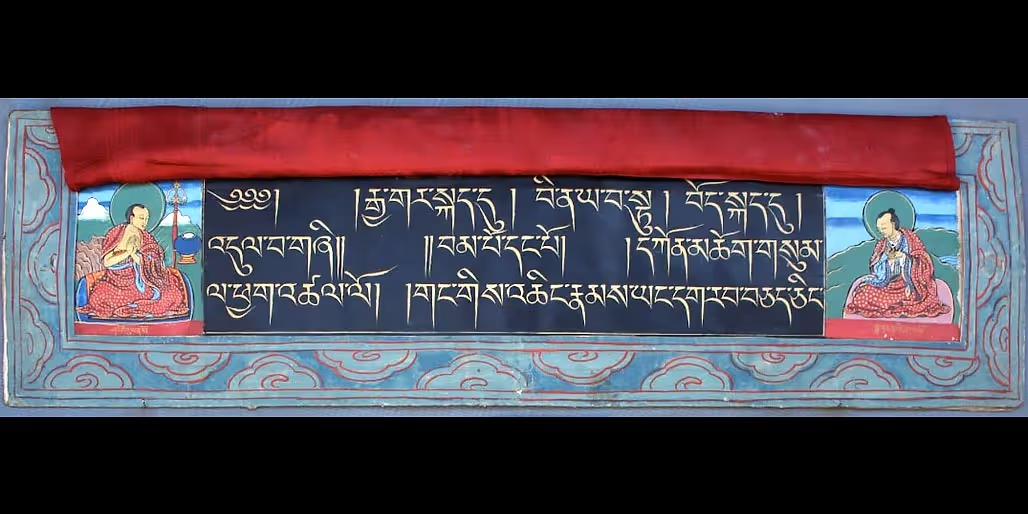
The texts of the Vinaya, or Discipline (’dul ba) comprise the monastic code, its history, and commentaries on it. As well as detailing all the rules to be kept by monks, nuns, male and female novices, and male and female lay practitioners, they include a wealth of history, biography, and narrative recording the circumstances under which each rule was originally introduced by the Buddha.
This section of the Kangyur corresponds approximately to the Vinayapiṭaka of the Pāli and Chinese Tripiṭakas. Since it was largely due to divergences in the details of monastic code that early Buddhist groups differentiated into various schools, the vinaya literature of each school is quite different. The Pāli vinaya is that of the Theravāda school, while translations of vinaya texts into Chinese include the more or less complete vinaya literature of five other Indian Buddhist schools.
The works in this section of the Kangyur were translated into Tibetan from the Sanskrit texts of the Mūlasarvāstivāda-vinaya, the vinaya tradition held by the first monks to bring their ordination lineage to Tibet. Vinaya texts of other schools do not seem to have been translated into Tibetan. While scholars disagree about whether there was a Mūlasarvāstivādin school as such, distinct from the Sarvāstivādin school, the Mūlasarvāstivāda-vinaya is a distinct body of literature many times longer than any other vinaya. It has survived in Tibetan, Chinese, and partially in Sanskrit in the form of manuscripts found in Gilgit. The Tibetan translations represent a more complete version than the Chinese. The Mūlasarvāstivāda-vinaya literature is notable for its historical and narrative richness and contains material duplicated in, or paralleled by, a considerable number of sūtras, avadānas, and other works and passages elsewhere in the Kangyur; it almost constitutes a canonical collection in its own right.
The seven works listed here can be divided into the four major traditional divisions of the corpus:
Dr. John Canti was a founding member of 84000’s executive committee and editorial team and is now senior editor.