Women are present throughout the Buddhist canon—as leaders, rule-breakers, survivors, and saints. Learn about some of the most compelling female figures in the Vinaya, the monastic code, and the unexpected range of human experience their stories contain.
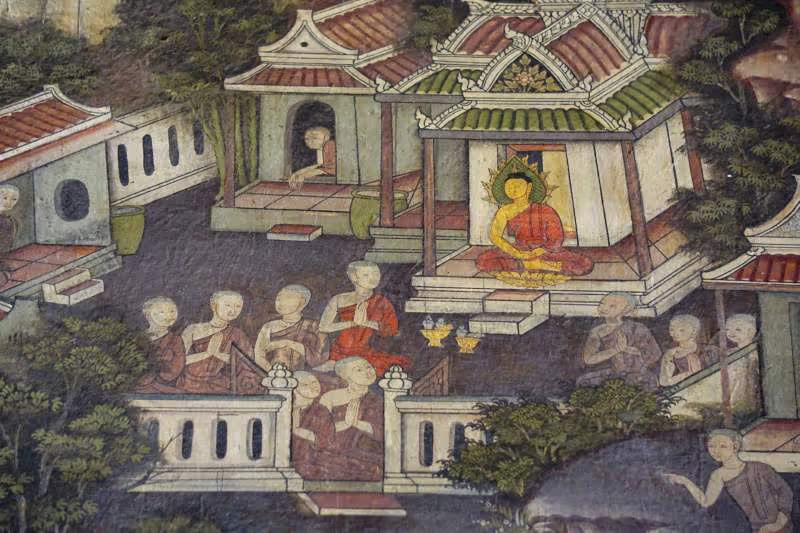
Mahāprajāpatī Gautamī and other early nuns are depicted in this painting at Wat Pho temple, Bangkok, Thailand. Source: Wikimedia Commons, CC-BY-2.0 license.
I first encountered Buddhist doctrine in a high school textbook my friend gave me. Like me, she was attending Catholic school in the Chicago area, but her curriculum included world religions. Until then, I had only encountered Buddhist ideas briefly while sorting books as a library worker.
It was an ordinary textbook, but I was hooked. I did some solid brooding as a teenager, so the idea that my own mind could hold the ticket to freedom from suffering was very appealing, even if it seemed like a remote possibility.
However, based on what I initially learned about Buddhism, women did not seem central to its story, an issue that I set aside for many years as I became more involved in Buddhist practice and study circles. Female meditation deities inspired me then, and continue to do so now, but I felt the need for some ground-floor inspiration from women who faced serious personal problems. I certainly had times when I thought my own personal struggles were somehow separate from these inspiring figures. I often felt as if my ordinary difficulties had no place in this world, and I just tried to ignore that gap in my appreciation for Buddhist sources.
It was years before I felt like I found what I was looking for. I found my people and their stories in the Buddhist canon. The canon is traditionally sorted into what is referred to as the three baskets, comprising the Vinaya, Sūtra, and Abhidharma. The first of the three baskets, Vinaya or monastic law, is full of stories featuring women from the Buddha’s life. Some of these stories are sad and deeply moving, and some are unexpectedly hilarious. Here are just a few of the women and their stories as told in the Vinaya.
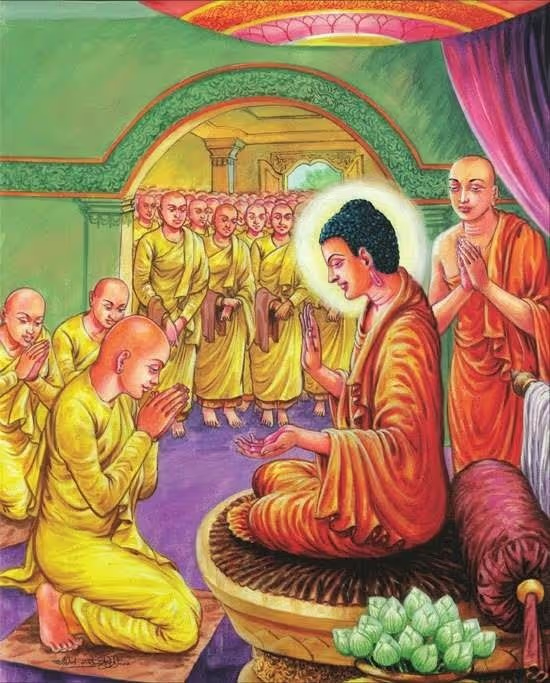
If we’re looking for inspiration on leadership and sovereignty for women who want to center their lives on renunciation, Mahāprajāpatī Gautamī is a wonderful example. According to these stories, Mahāprajāpatī was the Buddha’s aunt and adoptive mother, who cared for him shortly after his birth when his mother, Mahāmāyā, passed away.
She’s best known for her persistence in pursuing ordination for Buddhist nuns by repeatedly requesting that the Buddha establish a nuns’ order, eventually succeeding with the support of his disciple Ānanda.
However, Mahāprajāpatī’s story doesn’t end there. Reading about her repeated interventions as a leader, I see her as an expert in effective delegation and boundaries. When a householder asked Mahāprajāpatī to perform some task—cleaning or looking after a child, work traditionally seen as women's responsibility—she refused on the grounds that it fell outside her status as a nun—she even said that she hadn’t looked after a child since caring for the Buddha himself!
She’s often called upon to intervene when nuns push the limits of monastic discipline, communicating effectively with the Buddha and operating transparently as a leader.
In other words, because expectations for Buddhist monastics were still evolving in these stories—the lives of monks and nuns weren't yet fully defined—we can see Mahāprajāpatī asserting herself again and again to find the best path forward for herself and her fellow female monastics.
.avif)
Another foremost nun in these stories is Kṛśā Gautamī. When renunciant women are tempted to return to family life, Kṛśā is the one to point out its drawbacks. Her life as a wife and mother, before she renounced it and became a monastic, was marked by one tragedy after another, sometimes including extremes we would only see portrayed in horror films today (You can hear more about this in detail here, where I speak about her story on The Kind Heartfulness Podcast from Gomde). When she finally escapes from the last of those hardships, she wanders toward Śrāvastī, where she encounters the Buddha. Here is a part of the story from the Kṣudrakavastu (Toh 6), as condensed by Butön Rinchen Drup:
She was tormented by much suffering, and so, with wind rising and provisions lacking, she went mad, and cast off her lower garments. Her arms and legs cracked, her hair grew long, and, wandering about, she went to Śrāvastī. From a far-off distance, she saw the Buddha with the Saṅgha, explaining the doctrine. And so, having recovered her presence of mind, she was embarrassed, and sat down crouching to the side. The Teacher said to Ānanda, “Give Kṛśā a mantle.”
This passage brings me to tears every time I read it, imagining how the very sight of the Buddha restores Kṛśā’s mental state. Kṛśā goes on to become the foremost expert nun in Vinaya, monastic discipline itself, as she has no doubts about its efficacy after experiencing so much pain in household life.
Kapilabhadrā’s story includes a striking blend of positive and negative experiences during her lifetime as the Buddha’s disciple. What makes her story particularly complex are the past-life accounts (avadānas) that accompany it — stories that explain how her earlier actions shaped the experiences she encountered as the Buddha's disciple, offering us insight into the workings of karma.
Before encountering the Buddha, Bhadrā had always been extremely beautiful and inclined toward a celibate life from a young age—it’s said that when she and the man who became the monk Mahākāśyapa were married, they never consummated the marriage, going to extremes in their nightly routine to guard each other’s preference for celibacy. The couple eventually parts ways, each renouncing householder life and joining separate non-Buddhist renunciant groups.
Bhadrā experiences multiple acts of sexual violence in her renunciant group, and Mahākāśyapa then persuades her to join the Buddhist nuns’ order. After she is already an ordained, accomplished spiritual practitioner, she’s captured by one of King Ajātaśatru’s ministers and raped by the king, after which she escapes with the help of Utpalavarṇā, the nun foremost in magical powers (whose story I’ll tell another time). When she finally confronts the king, levitating into the air, he faints, begs for forgiveness, and becomes her lifelong patron.
Not all the stories about nuns in the Vinaya are about their virtue and accomplishments. The Vinaya is also full of stories about nuns who were foremost in troublemaking—and these actually receive the most attention and analysis. The ‘group of twelve’ nuns appear again and again, constantly prompting the Buddha to formulate new monastic rules with their antics. Sthūlanandā is the ringleader for this group.
It’s easy to remember the rules that are created to curb her exploits—she goes to such extremes that these stories can easily be classified as comedy. She shows up at the nunnery with a black eye after fighting and breaking people’s ribs, takes revenge on former suitors, opens a tavern, starts brawls, calls the other nuns names, and is always trying to make extra cash on the side in various ways. She particularly resents Mahākāśyapa, throwing a brick into a latrine ditch when he’s walking by and showing disrespect in numerous other ways.
While she’s certainly not a positive example in any sense, I’m always happy to see the full range of human behavior come to life when she shows up on the page—the Buddha, as a rulemaker, had to address all kinds of situations.
Some thirty years ago, when I first picked up that world religions textbook, I was certainly more of a Sthūlanandā type—moved by the teachings but turning to the Dharma with reluctance, hoping I'd never actually need to be on my best behavior. But I aspire to something different now. And I find it comforting to meet characters who rise out of the muck like the lotus to try something new. I hope you find them as inspiring as I do.

Dr. Annie Heckman holds MA and PhD degrees in the Study of Religion from the University of Toronto, an MFA from New York University, and a BFA from the University of Illinois at Chicago. She was among the first recipients of the Tsadra Foundation Dissertation Fellowship for Tibetan Buddhist Studies. She came to Buddhist studies from an early career as an artist, and her research is drawn to the intricate narrative world of monastic law, particularly the nuns whose rule-testing prompted the Buddha's earliest legislation.