Can the Buddha’s words be understood on their own, or do they need commentary to open them up? A conversation on The Heart Sūtra and The Perfection of Wisdom, with translators from 84000 and Khyentse Vision Project.
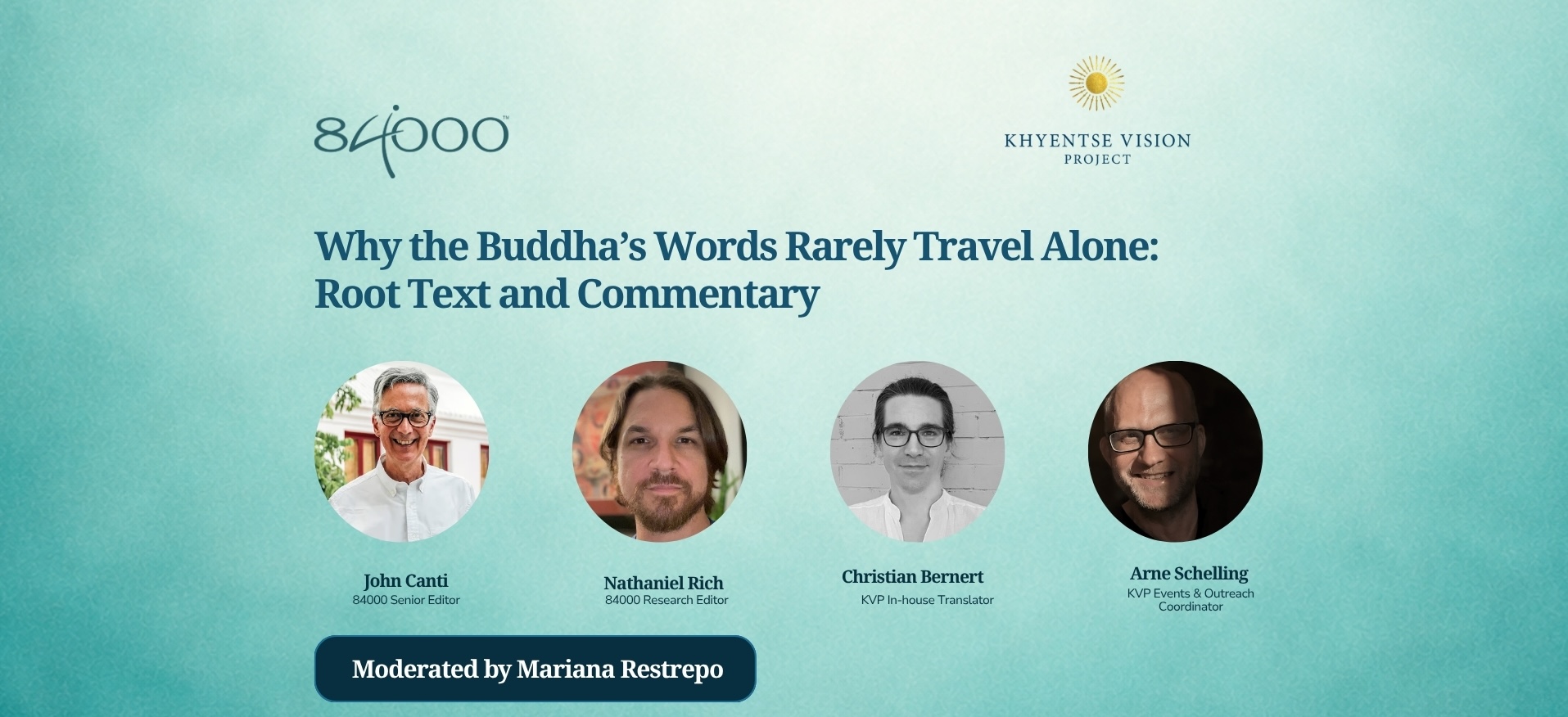
What is a root text, and what does a commentary do that the text itself cannot? In this conversation, translators from 84000 and Khyentse Vision Project explore the relationship between the Buddha’s words and the commentaries that open them up—from the Heart Sūtra to the vast Perfection of Wisdom (Prajñāpāramitā) sūtras they distill.
John Canti and Nathaniel Rich of 84000, who translate the sūtras themselves, are joined by Christian Bernert and Arne Schelling of Khyentse Vision Project, who translate the commentaries of the nineteenth-century master Jamyang Khyentse Wangpo—including his commentary on the Heart Sūtra, written when he was seventeen. Together, they examine how a translator moves between root text and commentary, how the commentarial tradition took shape, and what a reader gains from engaging with both.
The texts discussed are freely available to read at 84000 and Khyentse Vision Project. Links below.
Moderated by Mariana Restrepo.
The following transcript has been lightly edited for clarity.
Mariana Restrepo
Welcome. I’m Mariana Restrepo, public engagement editor at 84000. Today we’re exploring the relationship between two kinds of Buddhist texts: the root text and the commentaries. We’ll look at what a root text is, what a commentary is, and why they usually travel together.
This conversation is a collaboration between 84000 and Khyentse Vision Project. 84000 translates the entire Tibetan Buddhist canon, and Khyentse Vision Project translates the collected works of one of Tibet’s great nineteenth-century masters, Jamyang Khyentse Wangpo, which includes commentaries on many root texts.
I’m joined today by four people who have dedicated their work to these texts. From 84000, we have John Canti, our Senior Editor, and Nathaniel Rich, our Research Editor. And from the Khyentse Vision Project, we’re joined by Christian Bernert, their in-house translator, and Arne Schelling, their Editorial Research Coordinator.
Our common ground today is the Prajñāpāramitā, The Perfection of Wisdom, one of the most profound teachings in the Mahāyāna tradition. At its center are the sūtras themselves, from the very vast to the very short, like The Heart Sūtra, which have been translated by 84000, including the hundred-thousand-line, the longest sūtra in the whole canon. And around the sūtras are centuries of commentary written to open them up. This includes commentaries by Khyentse Wangpo, which Khyentse Vision Project has translated.
So we’ll begin there, with the sūtras themselves. Nate, let’s start with the root text. The Prajñāpāramitā isn’t a single text. There’s a whole range of texts, from something as short as one syllable to the hundred-thousand-line version. Why are they considered root texts?
Nathaniel Rich
The easiest way to answer is to say they are considered the word of the Buddha. In that regard, they are the root of The Perfection of Wisdom tradition.
If we think of The Perfection of Wisdom sūtras as a group, there are several different categories or classes of them. There are longer sūtras, like the Hundred-thousand-line Perfection of Wisdom, the Twenty-five-thousand-line Perfection of Wisdom Sūtra, and the Eight-thousand-line Perfection of Wisdom; and there are also a number of shorter sūtras. The long sūtras are said to be different records of the same teaching that the Buddha gave. In a sense, that is the root from which this very rich tree grows, and the different branches of that tree are these different root texts. The most famous is probably The Heart Sūtra. Those shorter sūtras seem to record other teachings of the Buddha—in the case of The Heart Sūtra, you’ll find figures like Avalokiteśvara. And we call them root not just because they record these teachings of the Buddha, but because they are the root from which the commentarial tradition grows. So root is always, I think, understood in relation to the commentaries that come later and that expound the meaning of those texts. This is why we call them roots: because there’s this intimate relationship between the root—the teaching of the Buddha—and the commentary that grows out of that teaching and unpacks its meaning.
Mariana Restrepo
Christian, in the case of the Prajñāpāramitā, we said some texts are really short, and others are very long, expanding on the shorter versions. But a commentary is something else. So what is a commentary doing that the expanded sūtra is not?
Christian Bernert
To differentiate, let’s say, a commentary on The Heart Sūtra from the more extensive Prajñāpāramitā sūtras: it really depends on the type of commentary. There are various commentaries that deal with root texts in different ways. I think what they all have in common is that they address one particular text and unpack the meaning that is explicit in that text.
In the case of the text I worked on with Khyentse Vision Project—The Heart Sūtra—the commentary that Khyentse Wangpo wrote is, I would say, almost a mixture of two kinds. There’s a word commentary, which unpacks each word: the commentary uses the words as they appear in the root text and then explains them. And then there are other commentaries that don’t necessarily follow the exact syntax, and don’t necessarily include all the words mentioned in the root text, but just expound on the meaning expressed in it. Khyentse Wangpo, in this particular text, kind of does both. Sometimes he explains each word, and sometimes he summarizes a section—he says this section begins with that word and ends here, and the meaning is this.
I think the main point of these commentaries, in particular for The Heart Sūtra, is that a lot of meaning is packed into it. It’s really an ideal text for commentary, because it condenses pretty much the whole of Mahāyāna thought into just a few verses, a few lines, and all that meaning can be expounded. There are a lot of commentaries on these texts. They can range from a little bit shorter than the root text itself to much, much longer—because there are sections that just mention, for example, the skandhas, and other sections that mention the twelve links of dependent arising, and each of these can fill volumes. So The Heart Sūtra is really an ideal vehicle to expound basically the whole of Mahāyāna. Everything is in there, if it’s unpacked.
Mariana Restrepo
John, to follow up on that—can you give us a little historical context for why this two-layer system developed—of having a root text accompanied by a commentary.
John Canti
Yes, I’ll try — it’s a huge subject. One thing that strikes me is that, in some ways, the Perfection of Wisdom isn’t a typical example of root text and commentary. For a start, we have quite a number of root texts that we would call the Perfection of Wisdom: the really long ones, the middle ones, and the short ones.
But to start by answering your question systematically: the Buddha’s word was a little bit like — nowadays you might go to a Dharma center, and there’s a teacher explaining some topic to the people present. He or she might not say everything that would be relevant to everybody. It might assume the people present already know quite a lot about the topic, or it might not. The Buddha’s teachings were a little bit like that. They were recorded, written down, and distributed. And later on, the great scholars in India particularly started writing explanations to expand and fill in the gaps and make them more suitable for people to study, from whatever their starting point might be.
Very often, the Buddha would pick topics here and there, say something about one subject, then move on to another, and there’s a kind of connecting narrative. If somebody wants to make a systematic study of what the Buddha said, it might be easier to have someone organizing the material for them, explaining what it meant and putting it in context. That’s the basic mechanism. And that’s why we have the division of Kangyur and Tengyur: we have the Buddha’s words, and then we have the commentaries—not everything in the Tengyur is a commentary, but we have the commentaries and treatises and other material written by the great scholars of India, and not directly the Buddha’s words.
The Perfection of Wisdom is a little bit different. Part of the reason is that the long texts, at least, are so long and so massive that for anybody to digest what’s in them would be a massive task. So in some ways the relationship between the root text and commentaries is quite different here, because the commentaries tend to be much shorter than the root text. The most important need for Perfection of Wisdom commentaries is to gather the essence, give you the most important message from this vast amount of material, and present it in a way you can deal with—if not in one sitting, at least in a humanly scaled amount of time.
Another interesting thing is that in some ways the short Prajñāpāramitā texts are themselves sort of commentaries. They take the essence, so even though they’re classified as the Buddha’s word, in some ways they are synopses or syntheses of what whoever compiled them thought was the most important message to convey from all this vast material. And of course we have commentaries on the short sūtras too. So if you take the short sūtras as sort of commentaries, and then they’re expanded again into longer commentaries, we get quite a complex situation in the relationship between all of these texts.
Nathaniel Rich
It’s as if there are no inherently existent root texts or commentaries.
John Canti
Indeed.
Mariana Restrepo
Arne, following on that thought—for someone who comes to a root text, or to these texts in the Prajñāpāramitā literature in particular, maybe someone who’s a practitioner or just a curious reader: where should they start? Should they start with the root text, with a commentary, or maybe both side by side? Is there a right order, or does it not matter?
Arne Schelling
I think it’s good to start by attending a teacher—that’s the best—someone who helps us navigate both the root text and the commentary. And then, from my personal point of view, I think it’s very fruitful to have both the root text and the commentary side by side, as you put it.
Because the root text itself—there’s a beauty in it. It’s poetic. There’s a blessing. You can memorize it. Especially with The Heart Sūtra, it’s really memorizable and recitable on a daily basis. But then we might miss many things, or misinterpret many things, if we don’t have a more elaborate guidebook around it. So on the other side of the table, it would be lovely to have a commentary, and even an oral explanation from a teacher, to unpack that and make sure we’re not going astray with our understanding.
So I think both are important. In the West, you always talk about head and heart. I think the root text is more for the heart, and the commentary is more for the head—to have that extra intellectual understanding of what is meant.
Mariana Restrepo
The following question is for both Nate and Christian next, but let’s start with Nate. When you’re translating a root text, do you usually reach for the commentaries as you’re translating? Or is there a case for deliberately not looking at commentaries and meeting the text on its own? How do you approach translating a root text?
Nathaniel Rich
Well, in the case of the sūtras in the Kangyur, the fact of the matter is that there are not very many Indian commentaries on those sūtras. So in most cases there isn’t a commentary to reach for. Now, that’s not entirely true in the case of the Perfection of Wisdom sūtras, of course. But in general, I think it’s important to try, as best you can, to encounter the sūtra on its own terms—just because the commentaries themselves might represent an understanding of the sūtra that is separated in time from the sūtra itself.
So there might have been developments in the understanding of the sūtra that may or may not reflect exactly the many voices with which the sūtra speaks. A commentary, as best we can tell, is almost always written by a single individual—to be fair, an individual who stands in a lineage of other individuals, but typically a commentary speaks with one voice. Whereas the sūtra may not speak with one voice. And that’s not just because you have multiple speakers in the sūtras, but because the sūtras often represent dialogues or conversations.
This is especially the case in the Perfection of Wisdom. In sūtras like The Hundred-Thousand, The Twenty-Five-Thousand, or The Eight-Thousand, it isn’t as if the Buddha is seated on a throne in front of an audience and the entire text is just the record of the Buddha expounding The Perfection of Wisdom. Much of what you find in these sūtras is, in fact, conversation between individuals. The Perfection of Wisdom is taught in the context of a dialogue—for example, between the Buddha’s disciples Subhūti and Śāriputra, or between one of them and the god Indra. So you have multiple voices clearly speaking in The Perfection of Wisdom sūtras, and the commentary is a single voice that attempts to unpack and make sense of those conversations.
So it’s really important, at least in the beginning, to try to encounter the sūtra on its own terms. But it’s also true that the texts themselves are not always easy to read, particularly because we’re reading them in Tibetan translation from Sanskrit or other Indic Prakrit languages. So the commentary is often very useful for making sense of passages that are difficult otherwise. The commentary is also a trustworthy guide for reading the sūtra—you can test your understanding of a passage against the commentator’s, and that sometimes makes it easier to understand the sūtra’s language.
And that’s not to say there’s anything wrong with reading a sūtra and a commentary together from the beginning—that can also be very useful. But in my experience, it’s interesting to read the sūtras on their own terms and see the potentially different perspectives the root text and the commentary take on the same subject.
Mariana Restrepo
Christian, on the mirror side of that—as someone who translates commentaries—do you first read the root text before reading the commentary? Do you also consult other commentaries on the same text as you’re translating? What is your approach to working with the text?
Christian Bernert
The text in question here, the Prajñāpāramitā, was easy because, like most people in touch with Tibetan Buddhism, I’d already read the root text many, many times, so I was very familiar with it. I actually translated the root text, The Heart Sutra, quite a number of years ago during my work in Nepal at IBA. I was familiar with the text on its own terms—however, only based on the Tibetan. I don’t know Sanskrit; I only know very limited Sanskrit, so I couldn’t really unpack the meaning based on the Sanskrit text. But I was familiar enough with it.
What’s interesting about this particular commentary is the way Khyentse Wangpo explains The Heart Sutra. First of all, he wrote it when he was seventeen years old, and according to his own colophon, he wrote it in a very spontaneous way, without looking at other commentaries. That is quite astounding, because he quotes from many texts in it. So at seventeen, he must have already had a very broad mastery of these scriptural traditions. And the way he unpacks it is sometimes, let’s say, a little unconventional.
So I read the root text in light of Khyentse Wangpo’s understanding, because my translation was not of the root text itself—it was the root text as embedded in the commentary. That meant I had to make some translation choices for the words of the root text as they appear in the commentary, different from how I had translated the root text on its own years ago.
And that’s very beautiful, actually, because it shows how a root text can be stretched in many directions. I once heard a lama say that root texts are a little bit like chewing gum—you can stretch them. I think that’s especially true in the Tibetan tradition, because the grammar is not as clear as the Sanskrit, as I’ve heard. You can interpret much more into the verses or lines of the root text, based on syntax and grammar, than you could in the commentary—which, especially in this case, is in prose, in fully formulated sentences with full syntax. And that’s the function: wherever there’s room for interpretation, the commentary takes a stance and says, this is how it should be understood. So you guide the reader from a particular perspective that the author is representing in that context.
Dzongsar Khyentse Rinpoche gave a talk on The Heart Sutra using Khyentse Wangpo’s commentary as a reference, and I think quite early in the talk he said it has a very Dzogchen flavor. It doesn’t explicitly mention that perspective, but a lot of the terms are a little unusual in what you’d call a standard sūtra context. And that’s possible—the root text lends itself to many interpretations, and the author offers the particular approach he’s taking at that particular time, maybe for a particular audience, or for whatever reason he chooses a particular lens to read the root text.
So in short: I was already very familiar with the root text, The Heart Sutra, and I discovered it anew through Jamyang Khyentse Wangpo’s words in this case.
Mariana Restrepo
John, following up on that line of thought and something Nate also mentioned, is that the commentaries come from a specific context and time. We have the early Indian commentaries, then Tibetan commentaries, and even now, a Dharma teacher or Rinpoche teaching a text is, in a sense, creating its own kind of commentary. The root text remains the root text, but these commentaries evolve as the place, the context, the audience, and the teacher change. Could you expand on that?
John Canti
I’d like to go back to what Arne said earlier—that the best way to study these texts is often with a living teacher. What’s really interesting about the commentaries is that, in a way, they are written records of the oral tradition that accompanies all the texts—at least in theory. It’s a little bit like: whoever was present at the Buddha’s original teaching on The Perfection of Wisdom, or teachings, if there were several occasions, would have absorbed and understood the message, and would have a kind of access in their own understanding, their own realization even, that they would pass on to the next generation of students and practitioners, to help explain it and help them get started. This would be handed down over generations.
There’s an important principle in Buddhist transmission: you don’t put your own interpretation into any scripture. You try to faithfully transmit what you have understood from your own studies, from your own teacher, rather than—as we tend to do in the West—adding your own thought. Creativity is not the point.
But where the differences between different commentaries given at different times become very important is that they are adapted to the needs of different audiences. This vast amount of material in the Perfection of Wisdom sūtras is a huge transmission of Buddhist theory of all kinds, leading in many directions. If it hadn’t been shaped by commentaries—which interpret it always according to the oral tradition, but in ways that are selective and designed to fulfill particular needs—it wouldn’t have taken so many different directions, and it would have been impossible for people to really fathom it in various cultures and countries and Buddhist traditions.
o, bearing in mind the real importance of the oral tradition that accompanies the texts all the time, one can see commentaries as a selective arrangement of everything a particular teacher has learned—from that root text, from that tradition, and from his or her own studies and experience around that text—presented in a way designed for a new audience.
It’s a very long and vast history for the Prajñāpāramitā, and it has gone in so many different directions. What we often say in our introductions is that the first phase of trying to understand the Perfection of Wisdom sūtras was in the writings of Nāgārjuna, which led to the Madhyamaka and to some of the non-dual traditions in China—Zen and Chan, and several different traditions of practice in China. The Root Verses on the Middle Way are, in some ways, a sort of commentary on The Perfection of Wisdom.
And then there was a very different direction the teachings took in India from the fourth century onwards, with Asaṅga and Vasubandhu. There’s Asaṅga’s wonderful story of how he received teachings on the Prajñāpāramitā from Maitreya, after many years of what he thought was fruitless practice, because he was determined to understand it and found it very hard. He was finally whisked away by Maitreya to Tuṣita to receive the so-called Five Texts of Maitreya, among which was this extraordinary commentary—again, much shorter than the main root text—called the Abhisamayālaṃkāra, The Ornament of Realization. That then formed the basis for studying The Perfection of Wisdom texts in the big monasteries in northern India, and was transmitted in the whole Nālandā tradition to Tibet, becoming the foundation of a very strange and complicated system of practice and study that we now have in Tibet and that exists to this day: Parchin (phar phyin, short for pha rol tu phyin pa), or Perfection of Wisdom studies.
It’s a kind of specialized subject where people almost disappear into another world. It’s almost remote even from the main traditions of study in the monasteries. People get into Parchin studies, and hardly anybody else can really understand what they’re talking about, because it’s very complicated. But it’s extremely interesting, and it forms the basis for a lifetime of study.
On the other hand, we get distillations of The Perfection of Wisdom and its importance that come into commentaries on all kinds of different subjects. For almost anybody who counts themselves as a practitioner, it’s extremely important to try to understand the basic message of The Heart Sūtra and what it’s saying. It’s not particularly easy, but it’s in almost a different world from the complicated studies that accompany the commentaries and sub-commentaries of the Abhisamayālaṃkāra tradition.
Mariana Restrepo
All of you have mentioned that these commentaries are not meant to be our own personal interpretation. So when someone writes a commentary, what makes it an authoritative commentary? How is it passed down in the lineage of a tradition? And are these commentaries being written down—are they teachings that were given and then recorded by someone else? How do these things actually become commentaries? Are they someone’s personal notes as they study a text, or something written down, or meant to be a teaching or explanation? How do commentaries come about, and how do they get passed down, recorded, and made part of the lineage and tradition?
Arne Schelling
I think there are definitely different types of commentaries, and we touched on that a little—Christian was already getting at it. Some masters write the commentaries down word for word. Others may write down only notes, and later their students put them together, compose a commentary, and form proper sentences from them. Or sometimes students receive the teachings and, with their trained memory, remember them and write them down later. So it differs a lot; commentaries come about in various ways.
And often it’s because that particular teacher is really focusing on that text and wants to transmit this particular text or tradition—like the Prajñāpāramitā or the Abhisamayālaṃkāra, which John mentioned—and therefore gives teachings on it repeatedly. That’s why many teachings were given, and the students then had a lot of material to write a commentary out of.
What I’d like to add is that the beauty of a commentary, as John also mentioned, is that it’s really for the audience in that situation, at that time. I think that’s a really big point. That particular teacher wanted to change the packaging, the presentation, a little bit—not change the content, but the packaging can be changed so that these teachings from the Buddha can be more understandable. I feel the commentaries always make it a little bit more customer-friendly, so to speak.
Mariana Restrepo
If a commentary is written for a particular time, audience, and context, what does a contemporary person gain from reading an Indian commentary, for example?
Arne Schelling
That’s why I thought it so important to have a living teacher, who presents it to us and makes it even more accessible—again, not by diluting or changing the content, but by a different packaging, a different way of presenting, with different reference points, according to whatever culture, situation, country, language, or background. So I think that gives a beautiful mixture: the root text, then the ancient commentary from Indian or Tibetan masters, and then the present presentation of a qualified master. Together, these three make it accessible.
John Canti
I’ll just add that I think commentaries come about in various different ways. In one way, they’re teachings—just like teachings to a particular audience. Some of the commentaries by Mipham Rinpoche in the nineteenth century, for example, were actual teachings, and somebody took notes—one of his khenpos—and afterward, in some cases even after he’d passed away, it was decided that this teaching was a particularly good and important one, the notes existed, and they could be made into a text that could benefit people beyond the original audience. That’s one way a commentary can come about.
But there are plenty of commentaries that were deliberately written to include the really important points, or to expand on particular aspects of a text, by a great teacher or scholar. And of course there are probably vast numbers of commentaries that have been written and then lost, that we don’t really know about—perhaps they weren’t particularly great, or perhaps it was just bad luck that they got lost. We know of some that are missing, that people know once existed and no longer do.
But the really important commentaries are the ones that have been really appreciated and used and found to be applicable. So we have this literature, from all through the ages, of commentaries and teachings that have been considered really important to help elucidate the meaning of a particular text, or to give it a particular slant or interpretation that has been found useful by generations of practitioners.
Christian Bernert
I wanted to answer along the same line John just did: the biggest decider is certainly the test of time, and what people find useful and authoritative. The question of authority is, of course, a very tricky one. Coming back to the example of Khyentse Wangpo: just by the sheer nature of who he was and what he produced, anything he ever connected to a pen he held in his hand is considered authoritative. Dzongsar Khyentse Rinpoche said in one interview—when asked whether we should prioritize certain things, whether certain things might not be necessary to translate—that Khyentse Wangpo is a completely awakened being, so even if he wrote, I don’t know, a birthday card, that too has that blessing and should be translated. I’m not repeating verbatim what Dzongsar Khyentse Rinpoche said, just the spirit of it as I understand it.
So the question of authority can be established by who that person was while they were alive and active, or by how they were recognized later on. But also in the texts themselves: in a lot of these commentaries, by necessity, the authors have to prove that what they’re writing isn’t just something they came up with because they felt like it. They have to authenticate their message by quoting other texts. So in the commentaries you’ll have not only explanations of the root texts, but very often the masters quoting from many different Indian śāstras, and maybe other authoritative Tibetan scriptures, and then proving their points with logical reasoning as well. If they establish their thesis through logical reasoning and with the support of recognized authority within the lineage—generally the great masters from India—that already gives a lot of weight to the commentary. Then, of course, it depends on the master’s literary skill.
If all of these things come together—along with so many other necessary conditions—these commentaries will be passed on and taught, hopefully, and eventually translated, as in our case here, and then hopefully read, and then hopefully discussed, as luckily we’re experiencing now. So there’s really a living transmission that happens on the basis of these commentaries, which are themselves based on the words of the Buddha.
John Canti
What you’re saying is really interesting, Christian, because you’re absolutely right—this whole tradition of basing the authority of what’s said in a commentary by quoting excerpts from a sūtra or a famous treatise is really important. One of the really interesting things we’ve found doing the 84000 work is that some of these four-line quotes are very well known, because they come up in dozens of commentaries to make or substantiate a particular point. A lot of the time people are familiar with the quotes but not especially with where they come from.
Sometimes, when an author was writing a commentary—perhaps sitting in a cave somewhere, or in a remote monastery without much library access—it wasn’t always clear what the title of the original work might have been. So one of the tasks of a translator nowadays is to trace the origin of a quote that might be a little mysterious, or where the title hasn’t been supplied. Looking for them, finding them, and seeing these sometimes quite short quotes in the context of the original sūtra—and to whom they were originally spoken, and under what circumstances—is a really fascinating aspect of exploring the canonical texts.
Personally, now, when I’m reading a commentary, and I come across a quote, I find it really interesting to go to the source of that quote—which is now possible thanks to some of the work 84000 has done—and actually read it in context, to see where it came from. You learn so much about the teachings, and about the ways the commentaries have been composed, and the immense amount of thought and knowledge that lies behind them. That’s a really fascinating avenue that opens up.
Christian Bernert
I want to add something to what Arne said earlier? Arne mentioned that sometimes a teacher may have a certain wish to pass on a particular lineage or teaching, and that reminded me of a teacher from the Sakya tradition called Rongtön Sheja Kunrig, who was very famous for his exposition of the Prajñāpāramitā teachings based on the Abhisamayālaṃkāra—which in itself is already this commentarial work by Maitreya that John mentioned earlier, an extremely short and cryptic text, really not penetrable without commentary. There’s a vast Indian commentarial literature on it, and then, based on that, Tibetan literature.
Rongtön’s teacher was a specialist in this literature, so he passed his knowledge on to Rongtön, who then elaborated on it and wrote many commentaries—I think a couple of word commentaries, and then commentaries on the difficult points, which is its own sub-genre of commentary literature. So he clearly had a very strong connection to that literature, and it was important to him that this knowledge be passed on.
What’s very interesting is that towards the end of his life—I think just the last three or four years before he passed away—he composed a number of texts, probably dictated to some of his students, that are sometimes just a few pages long. They explain the content of the śāstras, but from the practice point of view. That’s very interesting, because apparently he felt the need to express the practical relevance of some of these highly complex, philosophical treatises that might otherwise not be used as a basis for practice. For him, it was important to pass on that aspect of the teachings as well. So he composed, or dictated, a number of texts, including some relatively short commentaries on certain parts of the Abhisamayālaṃkāra. Really fascinating stuff.
Arne Schelling
Christian, what you just said was a commentary on my root text—so I’m commenting on it. Because I actually had Rongtön in mind when I said what I said. And I think what you just mentioned—that last part—also shows that these masters who wrote the commentaries really do it because there’s a need. I assume he had his more classical, scholarly commentary first, and he saw people studying it but then not really able to relate it to their practice, and therefore he felt the need to make it like a practice manual for the same text. I think that really shows what commentaries are about: to make it accessible and practicable, for those who want to.
John Canti
At the same time—you’re absolutely right that for us nowadays especially, the need is for commentaries and teachings that speak to us directly and efficiently, that really relate to things we can actually experience. But it’s also important not to forget this vast scholastic tradition in India and Tibet, which underlies quite a lot of the treatises—especially the Indian ones, but many Tibetan ones too—where people would spend years and years in full-time study of a particular root text, really getting into it, analyzing it, getting down to the word level and the sentence level: what things mean, and why we use this term, and so forth.
84000 published a translation of the eight-thousand-line Prajñāpāramitā not long ago, in which our translator, Greg Seton, put a lot of the famous commentaries by Haribhadra and Ratnākaraśānti into the footnotes. But Greg was saying, in his introduction and when talking about the text, that an awful lot of those commentaries are to us almost incomprehensible, because they’re analyzing the grammatical structure and syntax of the original work, breaking words down into their etymology, and so forth, and it really doesn’t make sense in translation.
So the commentaries are incredibly useful—incredibly useful for translators, and for people studying this material in real detail—but not necessarily something an average practitioner in a Dharma center, or somebody taking Buddhist practice very seriously for their own interest and inspiration, would need or want. It’s wonderful that those treatises exist, but not necessarily something they’d want to get into in great detail.
On the other hand, I wanted to mention an experience I had recently. I was editing and presenting a translation of The Diamond Sutra, which is probably the second best-known of the short Perfection of Wisdom sūtras after The Heart Sutra. It’s not as short as The Heart Sutra, but it’s something you can recite in a single sitting. When I first came across it, I found it almost impossible to understand—not that the individual statements were difficult, but they seemed to jump from one thing to another; there was a lot of repetition, and it really didn’t make sense as a text and as a teaching.
And I came across a commentary—actually shorter than the text itself —written by Asaṅga, translated and preserved in Tibetan, whose Sanskrit original was found in Tibet in the 1950s, I think. It suddenly made complete sense of the whole text. It explains what all the junctions between the different statements are and why they’re there, and it explains why there’s repetition—because the first time it’s from this perspective and the second time from that perspective—in an incredibly clear and illuminating way. To me that seems like an extraordinary example of what a commentary can do: to bring alive a text that is otherwise really quite difficult to understand, well known though it is, widely recited and used. Without that commentary—which of course found its way into the oral tradition, used in China and perhaps a little less in Tibet—the text is hard to use in practice. The commentary is really like a key that unlocks the treasures hidden in the original text, which are a little bit invisible at first.
Mariana Restrepp
Thank you, John, for sharing that. I’ll let Nate have the final word. As a practitioner—and thinking of the 84000 and Khyentse Vision Project audience and readers—as they encounter these texts, whether a root text or a commentary, what advice would you give them on how to approach the text, whether for reading or for practice?
Nathaniel Rich
As has been said, particularly in the context of practice, it’s crucial to have a living teacher if possible. But thinking in particular about the root texts, The Perfection of Wisdom sūtras—what might be most important for someone who approaches the text as a practitioner is to remember that what the texts are really pointing to, in the end, is an experience.
One thing that’s really fascinating to me about The Perfection of Wisdom sūtras is this: if you approach them from the perspective of the later tradition, and frankly in the context of some of the commentarial literature—for example, Madhyamaka commentaries—you might have the sense that what you’ll find in the root text is something philosophical, because what you encounter in the commentary, or what you might hear in teachings about the text, can sound somewhat philosophical—the philosophical idea of emptiness, or lack of inherent existence. And then when you come to the sūtras, what you’ll see very quickly is that there’s no philosophy in them. There’s no logical argumentation in them. You have dialogue and statements about The Perfection of Wisdom, and you begin to see that what’s happening is that The Perfection of Wisdom—which ultimately is not something you can articulate verbally, or even really point to—is nevertheless being evoked somehow.
So the advice I’d give when you encounter these texts is to attend to your own experience of that encounter with the text. What is it that the text might be trying to point out to you about your own experience? Because ultimately that’s what they’re really about—not conveying some intellectual information about the Perfection of Wisdom, but introducing you to the Perfection of Wisdom as such. So reading the sūtras really is a kind of encounter. You’re encountering the Buddha’s word, you’re encountering the expression of awakening. And what is that like? In that moment, when you’re reading a sūtra, you’re not just reading a text—you’re encountering something that’s pointing out awakening to you. What’s that like?
Mariana Restrepo
Thank you so much everyone. Thank you to the Khyentse Vision Project and 84000. And for those of you listening: please visit Khyentse Vision Project and 84000, where you’ll find the commentaries, the root texts, and all the different and wonderful translations these organizations work on—freely available and accessible to anyone who wants to explore them. Thank you all again for being here today and for this conversation.
Texts explored in this conversation, freely available to read online
From Khyentse Vision Project
Commentaries and related works from the collected writings of Jamyang Khyentse Wangpo.
The Light of Definitive Meaning
Jamyang Khyentse Wangpo's commentary on the Heart Sutra, translated by Christian Bernert — the text at the heart of this conversation.
Elucidating the Meaning of Rāhula's Praise of the Mother
Translated by Christian Bernert.
From 84000
Root texts of the Perfection of Wisdom referred to in the conversation.
The Heart of the Perfection of Wisdom, the Blessed Mother · Toh 21
The Heart Sutra.
The Perfection of Wisdom in One Hundred Thousand Lines · Toh 8
The longest sūtra in the canon.
The Perfection of Wisdom in Twenty-Five Thousand Lines · Toh 9
The Noble Transcendent State of Wisdom in Eight Thousand Lines · Toh 12
One of the six “mother” sūtras; gave rise to many Indian and Tibetan commentaries.
The Perfection of Wisdom in One Syllable · Toh 23
The shortest of all — the perfection of wisdom in the single syllable a.
The Diamond Sutra (Toh 16), discussed by John Canti, is being translated by 84000 and is not yet published.
The complete Perfection of Wisdom section (Toh 8–30) is available here: 84000 Reading Room — Perfection of Wisdom

Mariana connects diverse audiences with 84000's content in ways that are accessible, relevant, and inspiring.