After nearly ten years leading 84000's editorial work, Tom Tillemans reflects on his path from Western analytic philosophy to Tibetan Buddhist logic, his favorite sūtra, and why keeping the project's three-pronged approach in balance has been its greatest challenge.
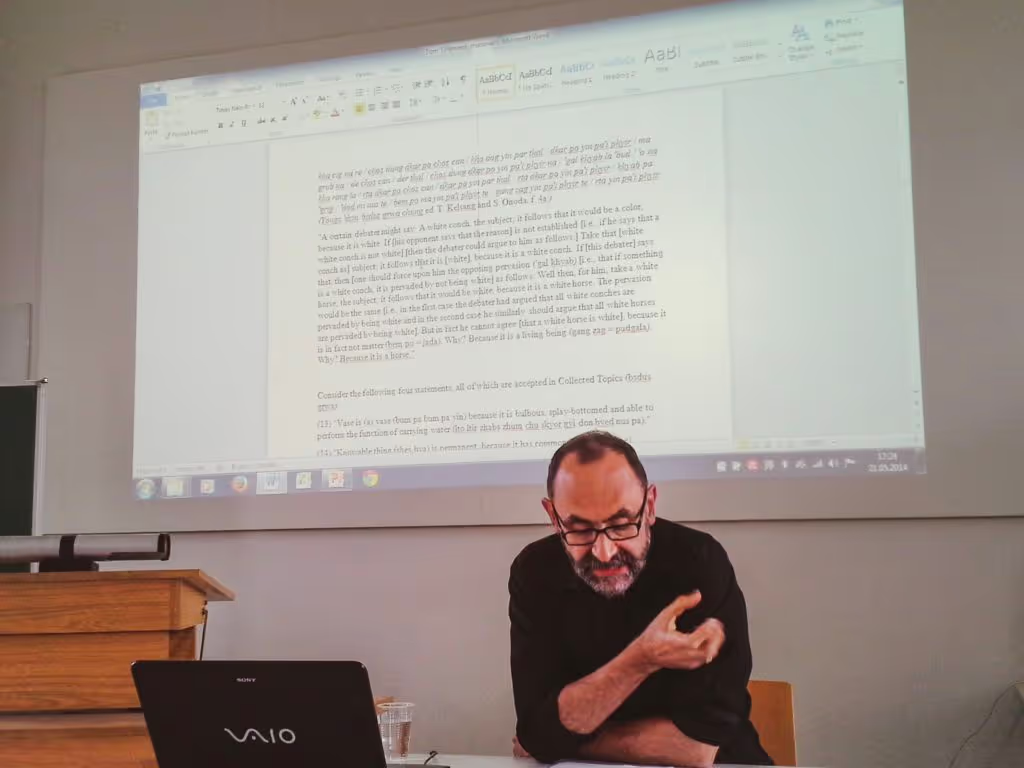
After almost ten years of service, Tom Tillemans, 84000’s outgoing editor-in-chief, has formally handed over the reins to his successor, and pauses briefly to talk with us about his journey, ‘problems of thinking’ that span both East and West, revelatory philosophical arguments in a recently translated sūtra; and the importance of maintaining a balance in our unique, three-pronged approach.
I was initially trained in Western analytic philosophy, and little by little took an interest in Asian thought, Buddhism in particular. I quickly realized that there was an enormous body of important philosophical thought that was largely inaccessible without knowing Asian languages. Although I had done some Sanskrit earlier in the late 1960’s in Canada with Professor Ashok Aklujkar, the first Buddhist texts I really got my teeth into were the basic Gelukpa logic texts following Tibetan exegesis of Dharmakīrti (6th-7th century C.E.). Those I studied in India and Switzerland in the 1970s; it was partly in studying those texts that I learned Tibetan – my teachers knew very little English. I began with the Buddhist epistemological tradition (tshad ma = pramāṇa), as it was there that I saw extraordinarily interesting ideas for comparative philosophy, and especially for better understanding the roles of logic and language in rational thought. I also got interested in Madhyamaka (dbu ma), inspired by Tibetans, but also by the Swiss scholar Jacques May, as it seemed to me then (and still does) a sophisticated quietism and critique of metaphysics.
When I went to Switzerland in 1975 I continued studying with Tibetans—Geshe Rabten in particular as well as others— many of whom lived in the refugee community in the German speaking area. Geshe Rabten was the abbot of a small Tibetan monastery in Rikon in the canton of Zurich; later he founded a much larger center near Lausanne, in the French speaking part of Switzerland. In one way or another, I and my fellow students managed to get to know quite a number of the older generation of Tibetan scholars.
In the 1980’s I did a second academic training in Lausanne, Geneva and then Japan, doing Sanskrit, Tibetan, Chinese, and more philosophy. I had the amazing good fortune of studying with Professor Jacques May, as well as Professor Shōryū Katsura, both of whom taught me over many, many years what the historical-philological method is about and how it can be combined with philosophical enquiry. (There is a danger of superficiality in doing Asian philosophy without sufficient knowledge of history and the languages.)
I have always considered myself a philosopher and do so now, although as time went on I saw an ever greater place for the rather different kind of understanding that literature and translation bring. In any case, the big problems of language, logic, metaphysics, ethics, and religious thought are important, whether one finds them in Aristotle, Wittgenstein, Quine, Zhuangzi, Tsongkhapa or Dharmakīrti. They are problems of thinking. What is perhaps surprisingly unimportant to me now is whether those problems are Asian or Western.
Some years ago, I worked on a rather exceptional sūtra called the Questions Regarding Death and Transmigration (tshe ’pho ba ji ltar ’gyur ba zhus pa’i mdo, Toh 308), which contains explanations of Buddhist views on the nature of life and death. The Sanskrit was lost, the sūtra was not translated into Chinese, and the Tibetan translation used a type of old translational language, what one found before the 9th century revisions and standardization. It was indeed an exceptional sūtra, because it read more like a treatise from the Tengyur—chock-a-block full of arguments. Interestingly enough, it hardly provided arguments for reincarnation—there was nothing like what you find in Dharmakīrti’s Pramāṇavārttika—but it had an impressive quantity of common-sensical reasoning against the conception of the after-life that one finds in the oldest corpus of Indian literature, i.e., the Vedas. The Vedic idea was that after death one would go to the “world of death” (yamaloka), sometimes called a “heaven” (svarga), and rejoin one’s various ancestors (pitṛ “fathers”), friends, relatives, and clan members, without reincarnating. Ritual played a huge role ensuring one’s passage to that realm and conservation of possessions once in it. The basic ideas obviously had a large popular acceptance in India, and not just in scholastic Brahmanical philosophies. It’s a conception that actually is prevalent in the West too—if you look around cemeteries, there are a surprising number of headstones with the inscription “We’ll be together again.” The sūtra was, in effect, showing how the new conception of liberation from birth and death– found in Buddhism, Jainism, and Upaniṣadic thought—clashed with the older Vedic conception of an eternal afterlife, and what a profound change this new idea was in Indian thought and, later, for much of Asia. The translation will be up on the 84000 site soon.
I joined 84000 because there was then—and there is now—a need to have an informed picture of Buddhism, one that can only come with good translations of the canonical literature. People will no doubt understand that literature in various ways, but it needs to be available. In a sense, our job as translators is to open things up. Practicing Buddhists will read the texts religiously and with devotion, historians may read them as giving a picture of India in a bygone era, philosophers may read them as presenting ideas and concepts relevant to their own thinking. The translations also have historical introductions, notes and glossaries, and in some cases, critical editions. But the idea is always to provide useful material for an informed reader, and not prejudge how he or she should actually read.
Dzongsar Rinpoche once said—quite rightly, I think— that we need to maintain a three-pronged approach, a kind of tripod, where one leg is the academic community, the other is the Tibetan community, and the third is the western and Asian Dharma community. The real challenge is to keep that tripod balanced. Pursuing those three orientations simultaneously gives the project depth.
I think that people in the 84000 know that I am a close friend of Buddhism, but that I am an independent. Chokyi Nyima Rinpoche once said in one of our organizational meetings, “Oh, don’t worry. He’s an independent. We had lots like him in Tibet.” That was a very memorable remark, quite touching. I think that diversity of views is a sign of strength in a project.
There is no doubt that 84000 would not have been the same without Tom Tillemans. Tom joined the project in the summer of 2010, when it had been running for just under a year. The main outlines of how the project would operate had been discussed, a few pilot translation projects had been accepted, but nothing had really started yet, let alone been published. Our name had just changed to 84000, from the initial, rather clunky, “Buddhist Literary Heritage Project.”
At the time, Tom was approaching the end of his tenure as Professor of Buddhist Studies at the University of Lausanne in Switzerland. He had been Head of the Department of Oriental Languages there, and Dean of the Faculty of Letters. His research had included comparative philosophy, linguistics, and epistemology; and as well as Madhyamaka and Pramāṇa he had acquired a deep knowledge of Tibetan grammar. He agreed to take part in the project during the first few years of his retirement, both as a member of the executive working group and as editor-in-chief.
Here, some of those who have worked most closely with Tom, pay tribute to his tenure, his contributions, and the incredible wealth of knowledge he has so generously shared with the world.
Most of us first met Tom in person at the third major meeting of 84000, which took place over a few days in Kathmandu in December 2010. It would be fair to say that his presence made itself felt immediately. He expressed his own independent-minded but very broad view of what the project’s goals, policies, and approaches should be, in no uncertain terms. If the word sycophant has an antonym, Tom probably embodies it. He was, however, scrupulously fair, ready to listen, and brimming with enthusiasm. Sadly, the great scholar Gene Smith, who had been a very active member of the planning team since the beginning, died only a short time after attending that same meeting. His death made it all the more important that we had Tom working with us, to hold the role that we somewhat mischievously termed “academic heavy-hitter.”
Tom’s philological and linguistic expertise was indeed an enormous help as we developed our approach to translating and publishing the canonical works. We decided we could leave aside for the time being the preliminary step that most academics saw as indispensable—the creation of full critical editions, documenting all the variant readings to be found in the different versions of the source texts, sometimes in several languages. That can take many years for a single text. On the other hand, we would not (as Gene Smith had initially envisaged) just post quick draft translations based on a single recension, which could later be improved and updated. Given the vast scale of the literature to be translated, the idea of coming back “later” to review and revise the translations could become an ever-receding aspiration. In between the two extremes lay a pragmatic compromise: we would take note of the most substantial variants—the ones that made a real difference to the interpretation of a text—and present careful translations along with introductions, notes, bibliographies, glossaries, and so forth, with enough contextual detail to satisfy most readers’ interest and indicate further resources, but without swamping them in a morass of specialist minutiae.
As well as helping shape the project’s policies in general, Tom has proved particularly skilled in applying them in practice, with the flexibility necessary for such a wide range of quite different genres. He has always been aware of the many kinds of readers we need to keep in mind—practicing Buddhists, naturally, but also academics and students, historians, people interested in the texts as literature, as religious or cultural expression, and indeed anyone curious enough to want to read them. Much of Tom’s work has been the detailed supervision and review of the many translator teams as they worked on drafting and refining their translations. Not only drawing on his deep knowledge of Sanskrit and Tibetan, but also deploying his skills as a teacher, communicator, and administrator, he has been able to raise standards and bring out the best in everyone. Homing in on a difficult passage to tease out its syntax, drawing on his knowledge of complex doctrinal points and terminology, encouraging the translator to keep trying, Tom has always had valuable contributions to make to each of our published projects, and indeed to many that are still in progress.
Tom’s retirement from his editorship of the project at the end of 2018 was thoroughly planned, and well in advance he anointed his own excellent choice as successor, James Gentry. The editorial team has been enriched with James’ exceptional scholarship and talent since October 2015.
Plunging into the Kangyur, so little explored, has been an extraordinary experience for all of us. To explore it in Tom’s company has been enjoyable work, and to spend time with him on so many memorable occasions, over a meal in Kathmandu, Seattle, or Colorado, strolling the streets and tea-houses of Delhi, rambling over the rolling Jutland coastline, listening all the while to his tireless conversation about everything and nothing, has been a huge pleasure. I have learnt so much from him, and am truly grateful.
We will miss him enormously, but have no doubt that his retirement, as he continues to explore everything—from exotic locations in South America to the mysteries of second century Indian metaphysics—will be rich and fulfilling.
I first met Tom in December 2010 in Kathmandu, during the third 84000 working committee meeting. Having just recently begun, we were searching for someone with expertise and high visibility in the academic world to bolster our editorial committee, to help set up our editorial systems, and to ensure the academic rigour and credibility of our translation work. At the recommendation of our advisor Chokyi Nyima Rinpoche—as well as our most respected colleague, himself an accomplished scholar, the late Gene Smith—we reached out to Tom, who was on the brink of retirement and open to exploring involvement with this young, new project.
Tom was confident, articulate, and definitely not shy about voicing disagreements where they inevitably occurred. He held some strong and well-founded ideas about policy issues and translation approaches, some of which he argued passionately, appearing at times, to be uncompromising. After two days of intensive meetings peppered with debates, Tom revealed a softer side to him, telling us he had been “acting tough” to see where our boundaries lay, how open-minded we could be, and how comfortable we were in being challenged.
It was then that Tom officially took on the role as our first editor-in-chief, and joined us as a working committee member. Tom played a vital role in setting up a system that ensured high editorial standards while skilfully avoiding the pitfalls of pursuing elusive and idealistic levels of perfection. In working with translators, scholars and reviewers, he displayed an extraordinary ability to straddle the fine balance between candour and tact. As a fellow committee member colleague, I’ve enjoyed working with Tom on various issues ranging from macro policy matters to details at the micro-level, and I admire his ability to speak his mind with respect and confidence, while also being so open-minded, willing to listen, and able to consider the merits of opposing points of view.
As perhaps befits Buddhist scholars, Tom and his editorial colleagues were keenly aware of impermanence, and they often discussed the importance of succession planning “in case someone gets hit by a bus.” And so, in 2016 he submitted a 3-year notice for his plan to retire from 84000, and identified an associate editor, James Gentry, as his successor. His farsightedness has enabled the editorial committee to transition smoothly between the two editors in chief, and to continue building on the foundation that he has established.
However, despite his impressive range of knowledge, and the depth of his skills, what left the deepest impression on me, was a very ordinary moment, while we stood and watched a musical concert put on by Khyentse Foundation at Shechen monastery in Bodhgaya: He turned his head to me and while we engaged in casual conversation—the content of which I no longer remember—I was struck by the gentleness and kindness in his eyes.
Though Tom’s presence with us will be missed, he remains a dear friend and a sound source of advice for us. No tribute could do justice to all he has contributed to the team, the project, and the Buddhadharma.
I have had the pleasure of working with Tom on Kangyur translations since he first joined the 84000 team in person for a week-long workshop, held at the base of the Shivapuri Hill on the outskirts of the Kathmandu Valley back in 2010. During this time, I have always been impressed by his interest in exploring Buddhism through a great array of textual, historical, and philosophical means in order to present this ancient tradition—for better and for worse—to a contemporary audience. The span of Tom’s academic interests ranges from the vast and timeless, such as the emptiness of Mahāyāna Buddhism, down to the minute details of Sanskrit and Tibetan grammar. Where else, but in Tom’s presence, can one receive a spirited discourse on the problem of solipsism in Cittamātra thought at one moment, and a detailed lecture on the split-ergative feature of Tibetan syntax the next?
Still, in spite of his obvious scholarly prowess, which he has so diligently and generously applied to his work at 84000 over the last decade, an equally positive aspect of his contribution to 84000, has been his appreciation of the living Buddhist tradition. Throughout his tenure as editor-in-chief it has always been clear that Tom maintains a natural fondness and respect for anyone who shares his passion for exploring Buddhist philosophy—whether they are dressed in monastic robes or tweed jackets never seems to matter. At the same time, this friendly approach to the monks, nuns and lamas who uphold the Buddhist tradition has always been reciprocal and the Buddhist teachers that Tom has met with through his work at 84000 clearly all cherish his company and appreciate his extensive knowledge of Buddhism.
One late afternoon, some years ago, Tom and I went to meet the great master Tsikey Chokling Rinpoche at his monastic residence by the great stupa of Boudhanath in Nepal. As soon as Rinpoche saw Tom, he joyfully exclaimed, “My dear professor!” and, inviting Tom to share his seat, Rinpoche spontaneously gave Tom a big kiss on the cheek. In a situation where many a distinguished professor might otherwise have felt awkward and uncomfortable, Tom was, although clearly surprised, also obviously appreciative of this unusual gesture of friendship extended to him in such a free and heartfelt manner. Although we—his editorial colleagues at 84000—may be less unrestrained in our show of appreciation, we are nevertheless equally grateful for Tom‘s contribution to the project, and his learned yet pragmatic approach to translation is sure to reverberate in our work for years to come.
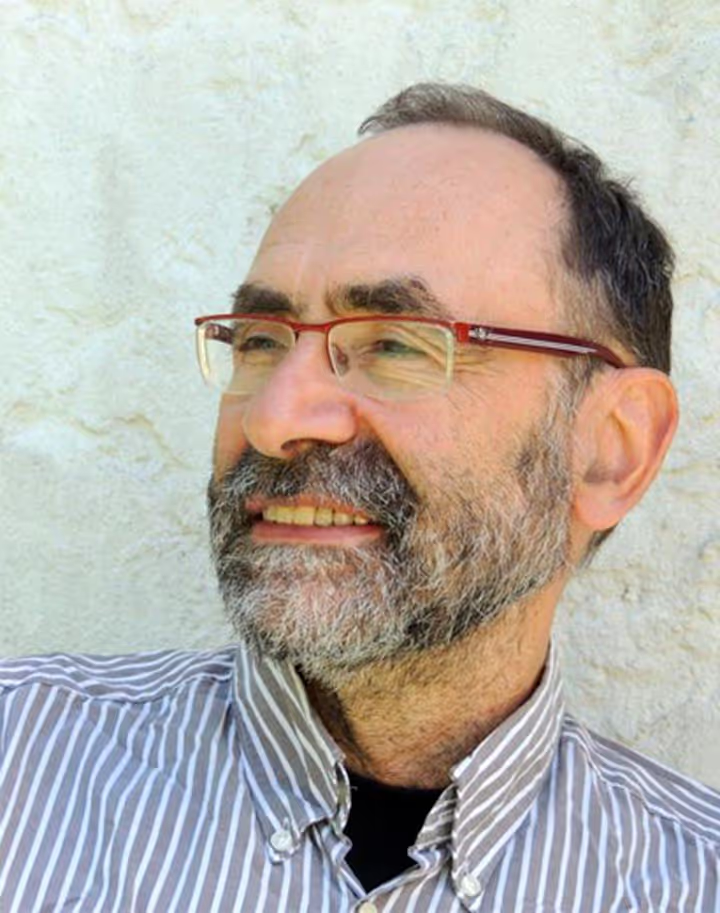
Dr. Tom J.F. Tillemans served as 84000 Editor-in-Chief from 2011-2019.