Dr. Catherine Dalton has interpreted for Tibetan Buddhist teachers and translated Buddhist texts for over two decades, and has contributed to 84000 since its inception. Here she reflects on approaching scholarship and translation as forms of Buddhist practice.
.png)
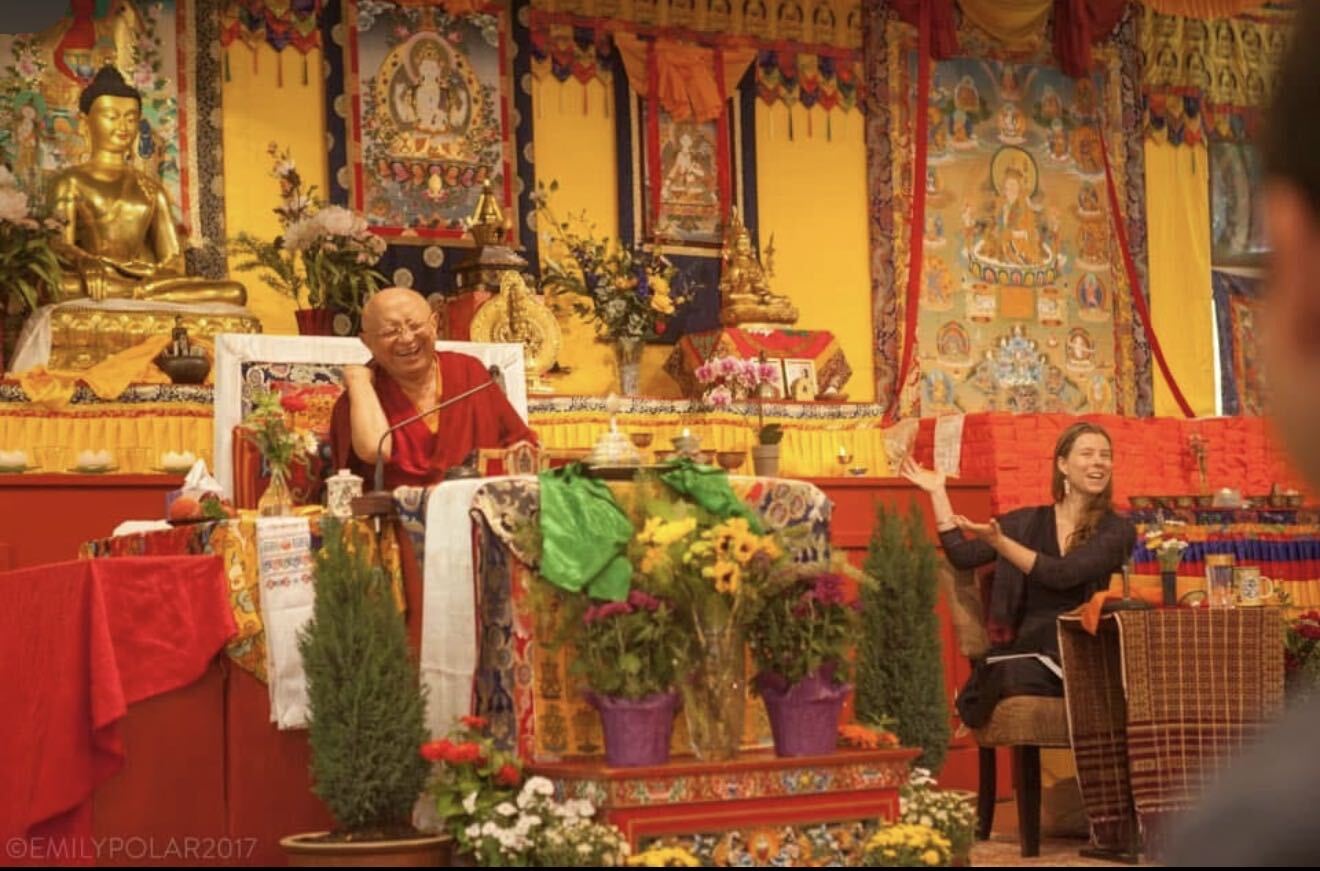
Chökyi Nyima Rinpoche with Dr. Catherine Dalton interpreting. Photograph courtesy of Rangjung Yeshe Institute.
Since the earliest days of my study of Buddhism and Tibetan language under the auspices and guidance of Chökyi Nyima Rinpoche, I have been encouraged to work toward being a scholar-practitioner. Fortunately, since that time I have found myself regularly surrounded by many excellent and diverse examples of what it looks like to embody such a blend of erudition and deep personal integration of Buddhist principles.
Following the traditional Buddhist framework of learning, contemplation, and meditation, which my teachers have invariably encouraged me to approach in an integrative way, I have tried to approach my work as a scholar and translator of Buddhist texts and teachings as a student of the Dharma. This approach has led me to countless moments of learning, which I try to let serve as gateways into experience and meditative integration, so that they can fulfill the purpose of every Buddhist teaching: to act as remedies for afflictive emotions and agents of personal transformation.
This traditional approach to the study of Buddhism brings benefit both in the context of modern academic Buddhist scholarship and translation. Study is, of course, a prerequisite to translation—we cannot translate what we have not understood. And its benefit is not limited to the personal development and transformation of the scholar or translator; it extends to those who read and benefit from their work.
.png)
Approaching the study of Buddhism within the framework of Buddhist practice brings a more multidimensional understanding of what we learn. When producing scholarship on Buddhist topics, this deeper, broader engagement improves a scholar's ability to truly understand a topic and, therefore, to communicate that understanding in their scholarly work. The scholarship of those who work within the framework of Buddhist practice carries a particular depth, one that comes from their practice-based relationship with the Dharma.
When we study Buddhist texts, I believe we ought to take seriously what those texts and their teachers tell us about how such study should be approached. The traditional Buddhist framework of learning, reflection, and meditation, presented in so many Buddhist texts and teachings, indicates clearly that study is never meant as an end in itself. The Buddhist tradition tells us that the purpose of studying the Dharma is to develop an understanding to be contemplated and then integrated into our direct experience through meditation. The teachings are not meant simply to be known or understood intellectually, because just knowing them does not really help us; an intellectual understanding is not transformative on a personal level. Change comes only when we take something to heart and integrate it into our experience.
The Buddhist tradition offers a number of metaphors meant to convey the detriments of studying the Dharma without integrating what we learn into our experience. To hear the Dharma but not assimilate it into our experience is to be like a river stone that, though immersed in water for thousands of years, is dry inside when broken open. Being surrounded by Dharma teachings does nothing if we don’t take them to heart. Their entire purpose is to be integrated into our experience so that they transform us. Otherwise, following another traditional metaphor, learning the Buddhist teachings intellectually without integrating them into our being could result in a situation like that of someone who dies of thirst right at the edge of a great river or lake—everything we need is there, but we are not using it for the beneficial purpose it is meant to serve.
This integrated approach to studying Buddhist texts also means approaching the tradition with a certain openness. Rather than closing doors by preventing an “objective” study of the tradition, this way of studying Buddhism integrated with practice opens doors to understanding. In this way, approaching Buddhist study within the framework of Buddhist practice deepens our understanding of the tradition and, therefore, the scholarship we produce.
Many of these same principles for approaching Buddhist scholarship apply to translation, as well. That is, if as translators we practice the materials we translate, specifically, or generally train in Buddhist practice, we are likely to be able to make better sense of what we read, and therefore understand it and be able to translate it better. This applies to diverse genres of Buddhist writings. It clearly applies to practice-based texts like meditation manuals and their commentaries. However, this is equally the case for philosophical writings—these are also meant to be integrated into experience through practice, and can therefore be better understood in that context. Even Buddhist histories, biographies, and other narrative literature are meant as didactic tools, showing us what the lives of great practitioners have been like and serving as inspiration and guidance for our personal practice. Since Buddhist texts in general are written for the purpose of Buddhist practice, it makes sense that a translator who is a practitioner and seeks to integrate the Buddhist teachings and principles into their own life would potentially be able to access the contents of these writings more directly.
But there are other factors, too, where relating to translation as a form of Buddhist practice can change the outcome of the translation. One important factor is motivation. Our motivation affects the outcome of anything we do. But with translation, if we approach translating a text with the intention of bringing about personal transformation through what we learn, and with the intention of bringing real benefit to the reader—or even bringing benefit to all beings by making the wisdom contained in the text more accessible in our world—that kind of intention brings something into the translation that is missing when such an intention is absent. I believe that a translation prepared with a genuinely altruistic motivation impacts a reader more deeply.
My personal experience translating within the framework of practice is that maintaining altruistic motivation and allowing the flavor of practice to enter the translation process affects and improves the resulting translation. Bringing the openness and freshness of meditation practice into the space of translation breathes a particular quality into the words that come out, and I think this makes those words and their meaning more available to a reader. The work done by translators I know personally who are serious meditators—especially translations of meditation manuals—has a particular flavor that makes it easier for me to relate to a text and its content in a more impactful way.
Another aspect of working as a translator who approaches translation as a form of Dharma practice relates to pride. I have heard my teachers say so many times, “On the ball of pride the water of good qualities cannot remain.” To be truly transformed by the Dharma, we must overcome pride, and when that is at least an aim we keep in mind, it also helps us translate more effectively, because we tend toward openness rather than closed-mindedness. This means that we can learn more—we can constantly learn from the texts we read, from our teachers, and from other translators. If we are constantly learning, we are always becoming better translators.
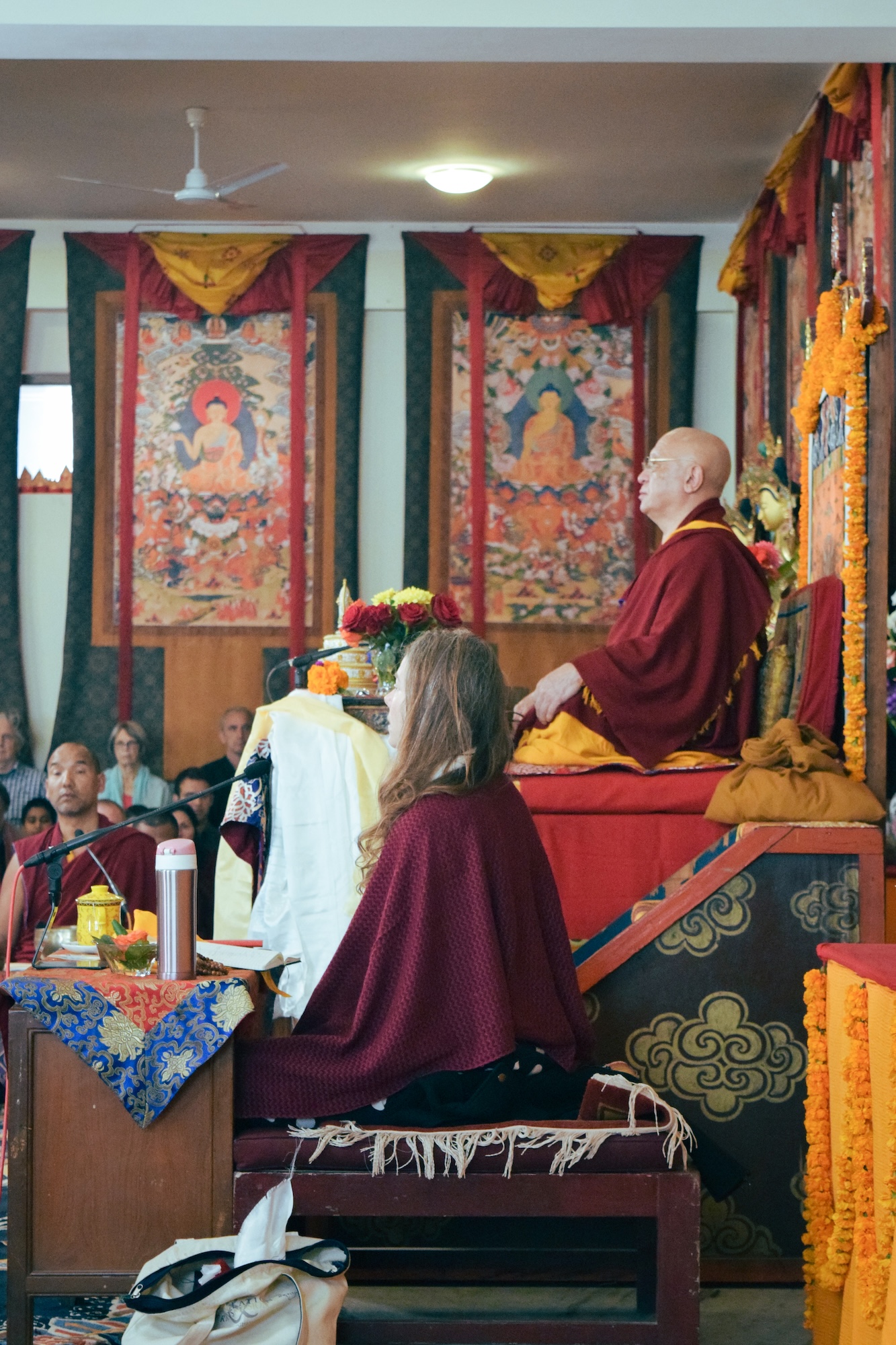
I have the fortune of working not just as a textual translator, but also as an oral interpreter. For me, that context—when the teacher is present, and a room full of Dharma students is also present—is one where embracing the translation environment with practice is almost unavoidable. This is especially true when translating for someone like Chökyi Nyima Rinpoche, who embodies the Dharma so fully that his presence naturally draws everyone into the space of practice. In any kind of Dharma oral interpreting context, I do the very same thing I would do in a meditation practice session. I begin by adjusting my motivation and reciting some prayers and supplications, then settle into practice, and at the end close with dedications. I am quite confident that using the same framework that I use in a meditation session for a translation session makes me a better translator. It allows for a kind of openness and ease, and I feel that it helps clear away barriers that I might otherwise unintentionally put up, barriers that could stand in the way of clearly interpreting my teachers’ words.
Buddhist translation has historically been approached very much within the context of Buddhist practice. During my doctoral studies, I spent some time researching the translators of some Guhyasamāja tantric materials preserved in the Tibetan canon. I examined the translators’ colophons—the short statements at the end of texts in which translators identify themselves and sometimes add comments about the translation sources, process, and location—and I also looked at Tibetan histories that discussed the transmission of the Dharma from India to Tibet. I found that translators who appear in the colophons of the textual tradition are often also listed in the histories as transmitters of those traditions, as lineage holders. This means those translators upheld the practice systems of the texts they translated. Setting aside here the question of lineage holders as Buddhism is transmitted into new cultures, the precedent of translators who practice the texts they translate is very clear in the historical context.
In our modern world, we likewise have many examples of translators who are practitioners—both outside and inside academia. As I mentioned, for me personally, texts translated by such practitioners bear a certain kind of impact that I believe is connected to the translators’ practice. Working as a translator in Chökyi Nyima Rinpoche’s community, I have always had as models excellent translators who are also serious Dharma practitioners. They have inspired me to try to uphold this tradition of pursuing translation within the context of Dharma practice.
The personal benefits of doing translation work as a Buddhist practitioner have been significant for me. As an oral interpreter, I receive many teachings, and as a textual translator, I spend a lot of time carefully reading Buddhist literature. In that sense, serving as a translator has given me the opportunity to study and learn a great deal about the Dharma. With translation, the added benefit is that it is not only a form of study, but also a process of internalizing something and then externalizing it with clarity. This process brings the Dharma deep inside, and it can therefore be a deep gateway to experience. When interpreting, I have noticed that sometimes I am particularly impacted by a statement when I hear the teacher say it, but other times I am more personally struck when I translate it. Sometimes articulating a statement about the Dharma is what makes it really strike home. Serving as a translator is also an opportunity to serve Dharma and our teachers by making the teachings more available to more people. From the Buddhist perspective, this means we can create merit by doing our job, which is also a gift and a blessing.
Returning to where we started: What does it really mean to be a scholar-practitioner? Or a scholar-practitioner translator? What does it mean to truly integrate study and translation with Buddhist practice? When we approach the study of Buddhism as practice, and endeavor to bring what we learn as students or scholars into our personal practice, I think the most important factor is leading with altruistic motivation and openness to genuine personal transformation. We can ensure that transformation happens by bringing study, contemplation, and meditation together as an integrated whole. The very same goes for translation. When we let what enters our minds on an intellectual level percolate down and enter our hearts, when we open ourselves to change for the better, and let translation take place within the space of transformative practice, it benefits us personally and as translators. This, in turn, benefits our scholarship and translation work and helps the scholarship and translations we produce have a deeper, more wholesome impact on those who connect with them.
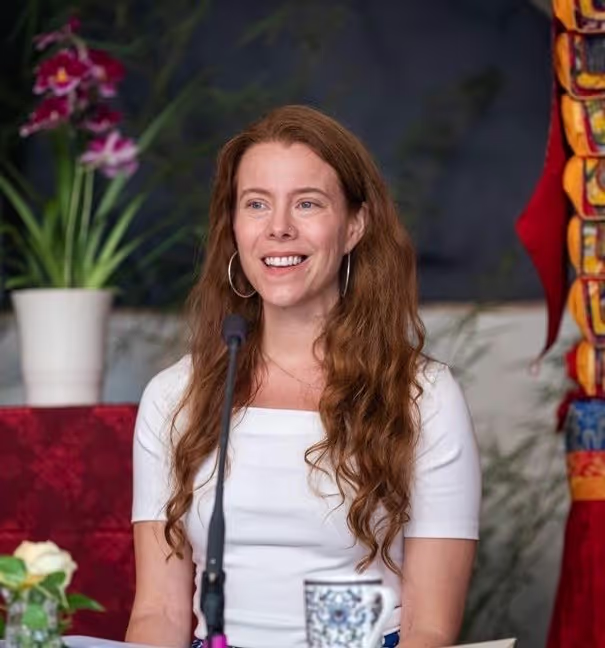
Dr. Catherine Dalton has worked as an interpreter and translator of Tibetan Buddhist teachings since the early 2000s and has contributed to 84000 since its inception, now as one of its in-house translators. She holds a doctorate in Buddhist Studies from UC Berkeley, teaches at Rangjung Yeshe Institute, and serves as an oral interpreter for Chökyi Nyima Rinpoche.